
/Swept%20Website/All%20Icons/icons/scheduled%20event.svg)




Keeping commercial spaces clean isn’t just about effort—it’s about consistency.
If you’re managing multiple cleaners, locations, or clients, you’ve probably run into the same problems:
missed tasks, inconsistent results, and confusion over what “done” actually means.
That’s where a janitorial cleaning checklist becomes essential—not just as a task list, but as a system for running your operations.
In this guide, we’ll break down what a strong commercial cleaning checklist should include, how to use it effectively, and how it helps you standardize quality across every job.
What is a janitorial cleaning checklist?
A janitorial cleaning checklist is a structured list of cleaning tasks organized by frequency, area, or responsibility.
In commercial cleaning, it’s used to:
- Standardize cleaning across locations
- Set clear expectations for cleaners
- Track completed work
- Reduce missed tasks and quality issues
At its core, it answers one question for your team:
“What does ‘clean’ mean in this building, on this job, every time?”
Why cleaning consistency is so hard to achieve
Most cleaning businesses don’t struggle because their teams don’t care—they struggle because expectations aren’t clearly systemized.
Without a structured checklist, you get:
- Different cleaners doing things differently
- Supervisors relying on memory instead of standards
- Clients noticing inconsistency between visits
- Extra rework that eats into profit marginsf
A checklist turns “best effort” into a repeatable system.
What should a commercial cleaning checklist include?
A strong janitorial cleaning checklist should be simple enough to follow—but detailed enough to ensure nothing gets missed.
Here are the core components:
1. Task frequency (daily, weekly, monthly)
Break tasks into repeatable cycles so cleaning standards don’t drift over time.
- Daily: trash removal, restrooms, floors, high-touch surfaces
- Weekly: dusting, detail cleaning, restocking
- Monthly: deep cleaning tasks like vents, carpets, or floors
2. Area-based cleaning
Organize work by space so cleaners can move efficiently through a building.
Examples:
- Restrooms
- Offices
- Entrances and lobbies
- Break rooms
This reduces confusion and ensures full coverage of the facility.
3. High-touch surface cleaning
These are often the most important from a client satisfaction and hygiene standpoint.
Include items like:
- Door handles
- Light switches
- Shared equipment
- Countertops and railings
4. Supply and restocking checks
A complete checklist should also account for maintenance tasks like:
- Restocking soap and paper products
- Replacing liners
- Noting supply shortages
5. Quality verification
This is what turns a checklist into a control system.
Add simple verification like:
- Initials or sign-off fields
- Supervisor review step
Completion timestamps (if digital)
How to use a janitorial cleaning checklist effectively
A checklist only works if it’s actively used—not just handed out.
Here’s how top-performing cleaning businesses use them:
1. Standardize it across all locations
Every site should follow a version of the same structure, even if tasks vary slightly. This creates consistency across your entire operation.
2. Use it to train new cleaners
Instead of relying on shadowing alone, the checklist becomes a step-by-step guide that helps new hires learn faster and make fewer mistakes.
3. Reinforce accountability through supervision
Supervisors should review completed checklists regularly to ensure work matches expectations—not assumptions.
4. Update it as operations evolve
As client needs change, your checklist should change with them. Treat it as a living system, not a static document.
Common mistakes with janitorial cleaning checklists
Even businesses that use checklists often run into the same issues:
Too vague
If tasks aren’t clearly defined, cleaners interpret them differently.
Too static
Outdated checklists don’t reflect real client expectations.
No verification step
Without accountability, tasks get marked complete but not always done properly.
Paper overload
Paper checklists are easy to lose, forget, or misfile—especially across multiple sites.
When checklists stop being enough
As your business grows, managing paper-based systems becomes harder.
You start dealing with:
- Missed tasks that no one catches in time
- Difficulty tracking performance across teams
- No visibility into real-time job completion
- Inconsistent communication between supervisors and cleaners
At that point, the issue isn’t effort—it’s system visibility.
Get the full checklist template
If you’re ready to put this into action, we’ve created a free downloadable janitorial cleaning checklist template you can use right away.
👉 Download the checklist template here
It’s designed to help you standardize cleaning across locations, simplify training, and improve consistency across your team.
Where Swept Fits In
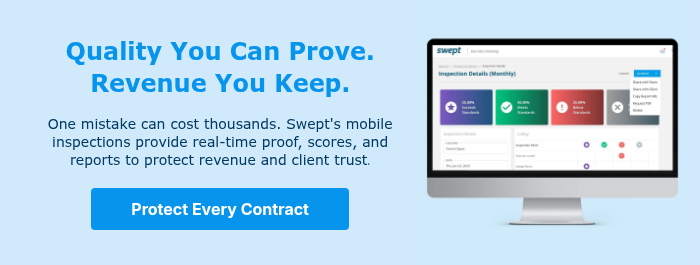
Once your checklist creates consistency, Swept turns it into a living checklist system—assigned at clock-in, tracked in real time, and used by your team on every shift.
Built for Consistent, Scalable Cleaning
Swept helps you standardize work across every location so quality doesn’t depend on who’s on shift.
- Standardize across locations so every site meets the same bar
- Reduce missed tasks with clear, structured expectations
- Build stronger teams by making “done” obvious
How It Works
Assigned at Clock-In
Cleaners get the right checklist automatically—no guesswork.
Real-Time Tracking
See progress as work happens, across all locations.
Clear Reporting
Get instant visibility and client-ready proof of work.
From Checklist to Control
When expectations are clear and work is visible, quality becomes consistent—and scalable.